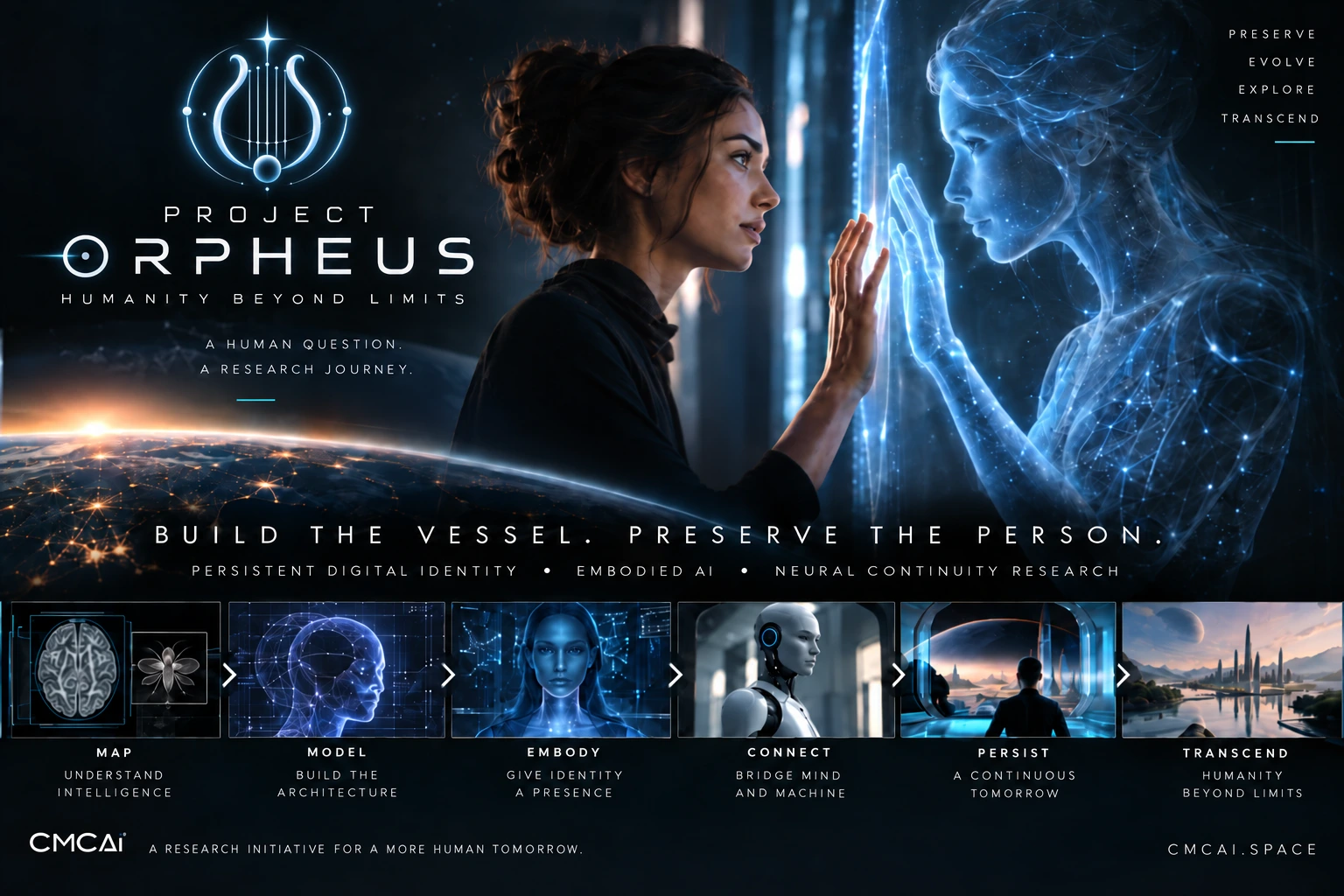
AI-generated concept artwork illustrating the long-term vision, not a working prototype or research result.View full-size artwork ↗
EARLY-STAGE PLANNING
Research status documented September 25, 2026. A working prototype and research results are not yet verified.
A HUMAN QUESTION. A RESEARCH JOURNEY.
What would it take for a person to continue?
The long-term ambition is to investigate technological immortality: whether an individual’s cognition could be preserved and potentially continued across computational systems and embodiments.
The first step is concrete. We want to build a digital persona with a traceable history, a persistent virtual space, and defined software state that can be saved, restored, and tested.
A convincing recreation would not establish that a person’s experience continued. Orpheus keeps that distinction central to the work.
THREE CONNECTED RESEARCH TRACKS
Build. Connect. Question what persists.
01
The vessel
Software we can test.
Plan persistent identity, source-traceable memory, a virtual habitat, and interfaces for voice, avatars, and compatible devices. Start with an original synthetic persona; treat any representation of a real person as a separate, consent-based undertaking.
PLANNED NEXT STEP
Define the first software demonstrator and its acceptance tests.
02
The bridge
Interfaces we can investigate.
Study published biological neural models through permitted datasets and simulations. Future work on human neural control and physical embodiment would depend on qualified partners, appropriate oversight, and demonstrated safety.
PLANNED NEXT STEP
Select a published model result for a bounded reproducibility study.
03
Continuity science
Claims we can examine.
Develop tests that distinguish stored records, preserved functions, individual fidelity, and human agency. The deeper question of subjective continuity remains open; negative and ambiguous findings belong in the record.
PLANNED NEXT STEP
Define what each test could establish—and what it could not.
THE PROPOSED FIRST PROTOTYPE
The first demonstrator.
A focused software demonstrator. These are proposed development targets, with final scope and delivery still to be defined.
01
Identity & memory
Versioned identity records, permissions, source citations, and clear handling of unknown or conflicting information.
WHAT WOULD COUNT AS EVIDENCE
Check retained records against a held-out test set and report errors.
02
A persistent habitat
One virtual room with saved objects, positions, and conversation context, plus a supported voice or avatar interface.
WHAT WOULD COUNT AS EVIDENCE
Show controlled changes surviving shutdown and restoration.
03
State across systems
An authorized session accessed through two interfaces, with declared application state restorable on a compatible host.
WHAT WOULD COUNT AS EVIDENCE
Publish the state boundary, version manifest, and restore comparisons.
04
A reproducible evidence package
Setup instructions, test conditions, limitations, and an honest account of the demonstration.
WHAT WOULD COUNT AS EVIDENCE
Let an independent reviewer repeat the supported process.
THE INTENDED FIRST DEMONSTRATION
A record. A room. A restart.
An original test persona receives a permitted record, answers with its source, and moves an object in a virtual room. After shutdown and restoration, the defined record and room state are checked. A second interface then accesses the same authorized session.
This would test specified software functions under stated conditions. It would not demonstrate a human mind upload, biological-memory extraction, or preserved subjective experience.
RESEARCH STATUS · SEPTEMBER 25, 2026
The groundwork comes first.
The current foundation is a research thesis and drafted roadmap. The next milestone is a defined, testable prototype scope.
Established direction
The Project Orpheus identity, adopted research thesis, and proposed first software demonstrator.
Drafted planning
Architecture, development gates, proposed deliverables, and a founder-led communications plan.
Not yet verified
A running Orpheus prototype, reproduced biological-model results, robotics or BCI integrations, and scientific partnerships.
Funding readiness
Prototype evidence, costed scope, and delivery obligations come before a campaign. No funding target, campaign launch, or reward offer is announced here.
BRAND UPDATE
Project Orpheus. Humanity beyond limits.
The project’s website now reflects the Orpheus name and visual identity. The research mission and proposed demonstrator remain the foundation of the work.
PROJECT NOTE
From the research question to a first milestone.
The version 1.0 project brief records the adopted thesis and proposes a demonstrator built around traceable memory, a persistent habitat, and verifiable state restoration. This is a planning milestone; technical implementation remains unverified.
THE ADOPTED RESEARCH THESIS
Build an embodiment-independent architecture capable of housing a persistent digital identity and progressively integrating neural control, sensory embodiment, memory, cognition, and external computation. Use increasingly capable biological interfaces to investigate whether human agency and cognitive function can be continuously distributed from biological tissue into an artificial substrate, ultimately studying whether continuity can persist through the natural loss of biological function.
This is a research objective, not an achieved result or a promise of future capability.
WHAT CONTINUITY MEANS
Different questions. Different evidence.
Data continuity
Do the declared records and software state survive a restart or compatible restoration?
Functional continuity
Are defined capabilities preserved under controlled tests, with errors and changes measured?
Subjective continuity
Does the same individual’s experience continue? Stored records or convincing behavior alone do not establish this.
Orpheus is not offering mind uploading, medical treatment, or enrollment in human experiments. Future human or end-of-life research would require qualified partners and independent clinical and ethical oversight. Following or supporting the project does not confer access to such research.
RESEARCH FOUNDATIONS
Start with the source.
Published work provides questions and methods to investigate. These are external studies, not Orpheus results or endorsements.
A study of brain-to-voice synthesis, relevant to a defined neural communication capability.
FOUNDER-LED RESEARCH
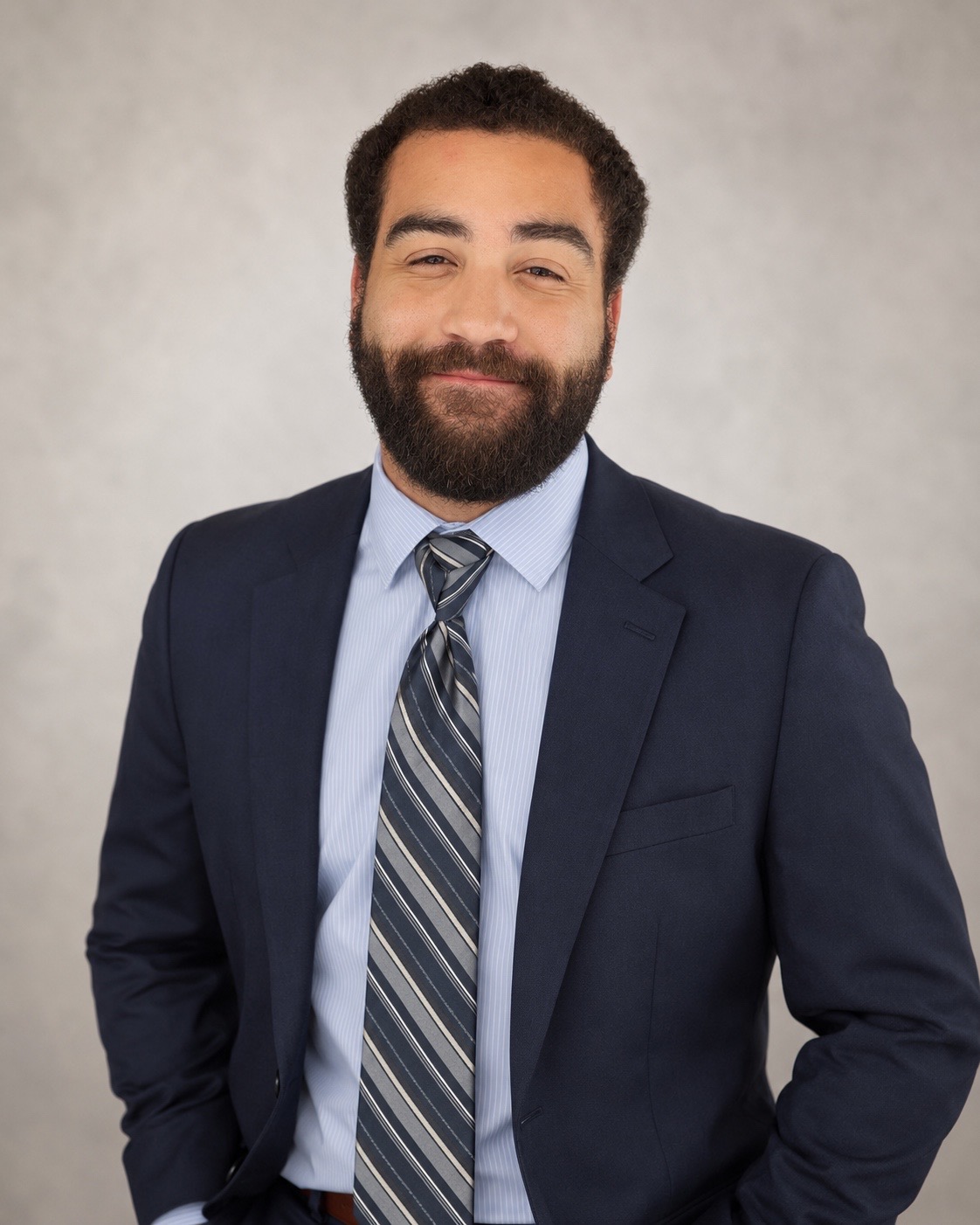
Connor Myrick-Cox
Founder & Chief Developer, CMCAI
Connor leads Project Orpheus with a commitment to making the research question, proposed work, and limits understandable. The aim is to document design decisions, real tests, and setbacks as the work develops.
Orpheus has its own research scope. Central AI remains CMCAI’s workforce and governance system; Nexus and Norse Build are separate projects.
Follow CMCAI’s channels for project news. Builders, researchers, and potential sponsors can contact Connor to discuss a defined contribution or next milestone.